Your first shift: what the shop actually asks of you
The shop does not tutorialise. It hands you a floor covered in dice, a panel that reads out what you are holding, and a display with nine slots. Here is what those three things are actually for.
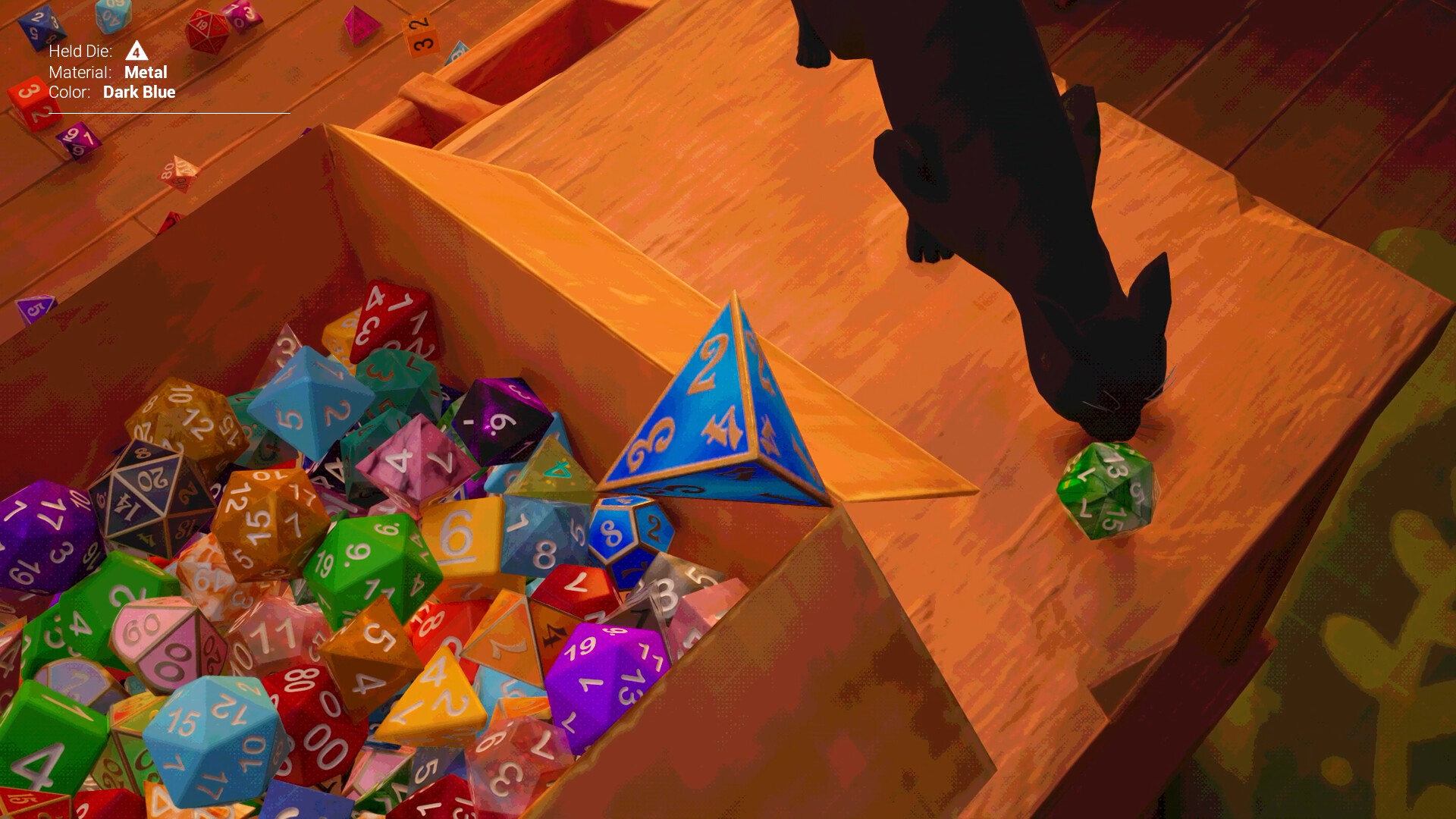
The first thing Dice Hoarder does is refuse to explain itself slowly. You are standing in a shop with dice on the floor, on the shelves and in crates, and the only instruction that arrives with any force is a rule about a room you are not supposed to enter. Everything else you learn by picking something up. That is deliberate, and it works, but it helps to know what the interface is quietly doing for you.
The panel on the left is the whole tutorial
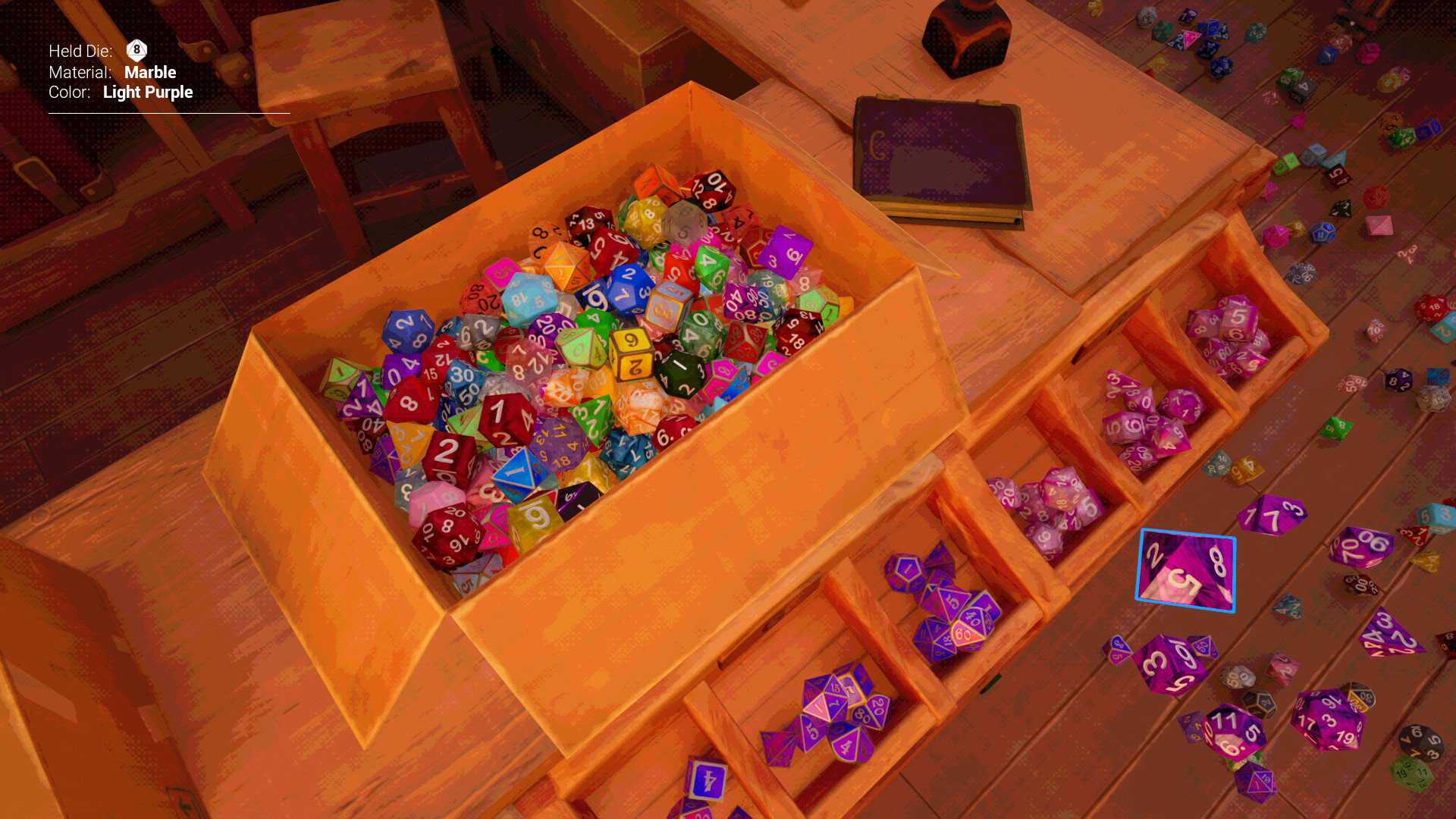
A panel on the left of the screen shows the material and colour of whichever die you are holding or have selected in your inventory. It is easy to read this as decoration for the first ten minutes, because colour is obvious — you can see that a die is red from across the room. Material is the part you cannot reliably judge. Two dice can share a colour and differ in finish, and under a shop’s warm lighting the difference is exactly the detail a player gets wrong repeatedly. Rather than making the material more legible in the world, the game states it in plain text and expects you to read it.
The habit worth building immediately is to check the label before every placement rather than after a set fails. Shape and size you can judge by eye; where a piece belongs you can judge by eye; material is the one decision the eye is bad at, and it is the one the panel exists for. A set assembled on colour alone will look finished and will not stock.
Nine slots is a job, not a shelf
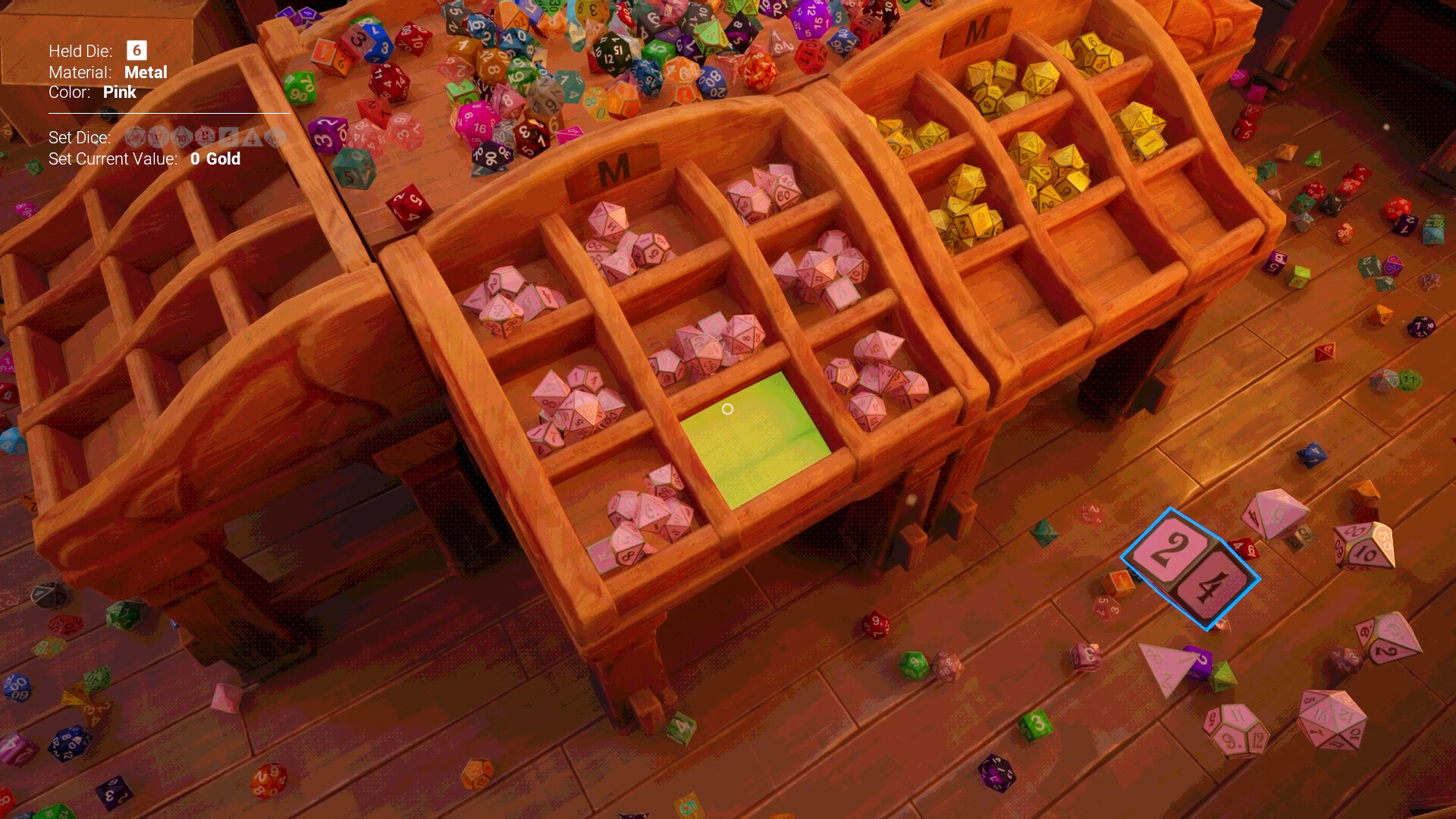
Dice go onto a display with nine slots, and the game counts a display as properly stocked when all nine are filled — there is an achievement for it, so the number is official rather than guessed. Nine is a useful target for a first session: small enough to finish, large enough that finishing it teaches the matching rule properly. A second achievement settles how the slots behave: you can fill a single slot with seven dice drawn from seven different sets. A slot is not the fixed home of one particular set. It takes seven dice, and the game checks what you put there.
That distinction is the difference between sorting and shelving. If every slot demanded one predetermined set, the job would be a lookup — find the seven pieces that belong together and drop them in. Because a slot accepts any seven, the job becomes a decision about which dice to present together, and the game is honest enough to reward the worst possible arrangement with a badge of its own.
When the shelves run dry, you make dice
The shop runs low on stock, and rather than letting you wait for it to refill, the game lets you craft custom resin dice to fill the gaps. Sorting stays the centre of the work, but crafting is the one system that hands you the tools instead of the inventory: you decide what the die looks like, and then you have to place it like anything else. The first one you make fires an achievement, which is how you know the system is meant to be found early rather than ignored.
What crafting changes is your relationship to a gap. A set missing one piece used to mean a search; now it can mean a decision, and the decision is bounded by the same rule as everything else, because a die you made still has to satisfy colour and material to belong. This is exactly where the identification panel earns its place a second time: when the die in your hand is one you built rather than one you found, the label is the only thing telling you whether it will actually fit.
Nothing in the shop has a clock on it
In Story Mode the next day begins only after you have stocked the day’s required value of dice, and there are no timers anywhere in the loop. That single design choice reorganises how you should play. The pressure comes from a target, not from a clock, so the efficient approach is to plan a set, close it, and only then decide what to do with the remaining time — rather than sweeping the floor until something interesting appears.
The other half of the pacing is that the mystery advances on days completed, not on time spent. If you want the story to move, hitting the day’s stock value is the only lever you have. If you would rather not be pushed at all, the game ships a second mode that drops the narrative and the targets entirely, and the developer’s own announcement for it uses a different name for the same idea — so do not go looking for a third option that does not exist.
A first session worth copying
Pick up five dice and read the panel for each before you place anything. Fill one display slot to seven and check it stocks. If it does not, the odd die out is almost always a colour-match with the wrong finish — pull it and the slot closes. Then take the day’s stock target seriously enough to finish it, because that is what advances the shop, and leave the loose dice on the floor. They will still be there tomorrow, and by then you will know the room well enough to clear it in half the time.
Where this comes from
Source · tier 1
“The panel on the left of the screen shows the material and colour of the die you are holding or have selected in your inventory, so you can identify it by reading the label.”
Source · tier 1
“Lawful Organised — Fully stock a nine-slot dice display. Misfit set — Fill a display slot with 7 dice, each from a different set.”
Source · tier 1
“The shop is running low on stock, so you will be able to craft custom resin dice to help fill the gaps.”
Source · tier 1
“There are no timers and no need to rush. In Story Mode, the next day begins only after you have stocked the required value of dice.”
Source · tier 1
“Zen Mode lets you settle in and restock the shop without interruptions.”
Checked 2026-11-14 against game version 1.0.