Five of the eight skills, finally named
The store page describes two disk powers. The achievement list proves eight exist. Actual play now names five of them, and shows what each one is actually worth in the shop.
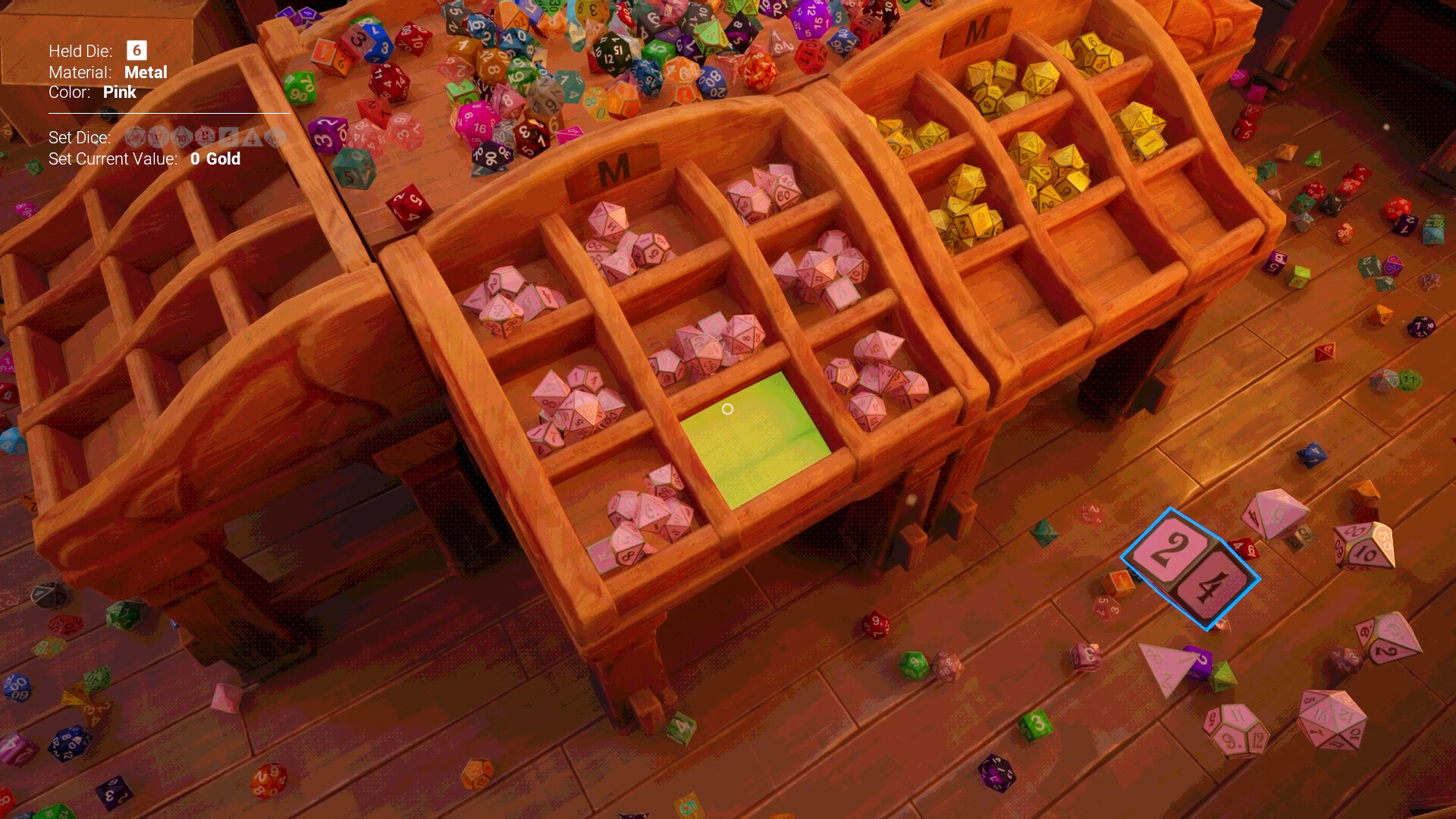
Dice Hoarder has an unusual problem for a guide: its progression system is well documented in aggregate and completely undocumented in detail. Steam confirms there are eight learnable skills, all upgradeable, and that finishing the shop without any of them is possible and separately tracked. What no official page does is name a single one. The store copy describes two powers in plain language — tracking the dice still missing from a set, and pulling a die straight into your hand — but never tells you what the game calls them.
That gap has now closed partway. Playthroughs from the first two days of release put five skill names on screen, each with the one-line description the game prints beside it. None of this is inference: the names and their effects appear verbatim in the skill panel, and they are reproducible by anyone who loads a save with skill points to spend.
What the five do
Nimble Step is the cheapest and the first most players meet. Its line is simply that it unlocks crouching, and crouching is not cosmetic: a large share of the shop’s loose dice sit below waist height, on floor shelves, in crates pushed against walls, and under counters. Until you can crouch you are sorting the top half of a room and walking past the rest. That is why it reads as the tutorial skill even though nothing forces you to take it first.
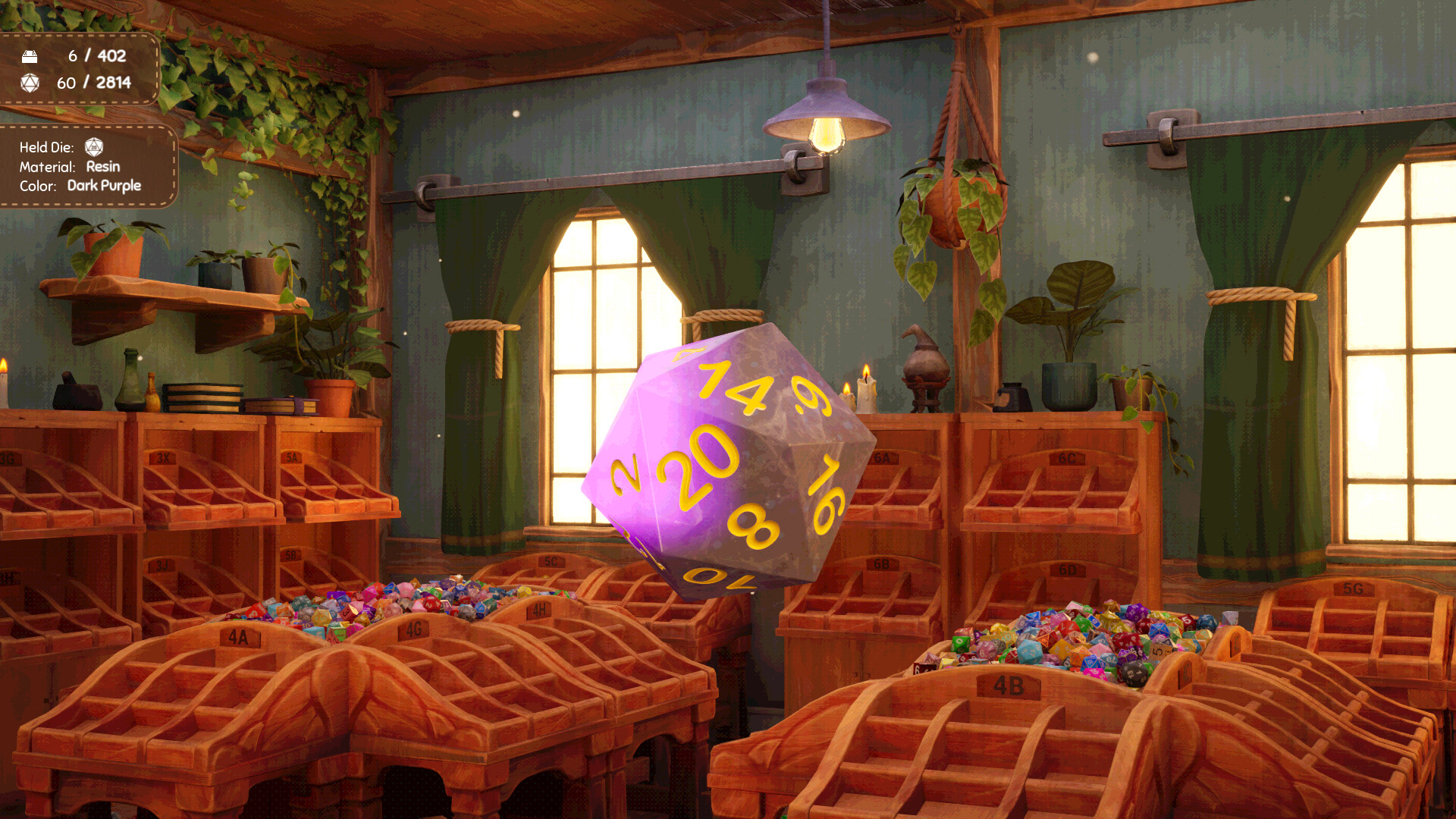
Extended Reach is the next one most people notice, because its absence is felt constantly. Its line is that you can pick dice up from further away. In a first-person shop where every set is assembled from pieces scattered across several displays, reach is a travel tax: you see the die you need, you are two steps from it, and the interaction prompt will not fire. Extended Reach does not remove the walk, but it removes the fiddly final adjustment, and over a long shift that is the difference between a rhythm and a series of small corrections.
Fleet Foot is the sprint. Its description is blunt about it — move around the shop faster — and it is the one skill whose value depends entirely on how you play. One player who took it early concluded the shop was small enough not to need sprinting, and that is a fair reading of a single-room floor plan. The counter-argument arrives later, when a shift’s stock target starts demanding trips between distant displays and the back room, and the walk becomes the largest single cost in the loop.
True Sight is the most interesting of the five, because it is the one that changes a decision rather than a movement. Holding a die and activating it highlights nearby dice that belong in that set. Note the wording: nearby. It is a radius, not a map. Players who expected a tracker that points at the missing piece across the room found it useless — one early adopter activated it, saw nothing highlighted, and concluded it did nothing at all, when the actual problem was that no matching die was inside the radius. Used on a set that is one piece short in a cluttered corner, it is the fastest tool in the game.
Dice Summons is the fifth and the only one that produces stock rather than revealing it. It summons two missing dice from a set directly into your hand. The upgrade line makes the trade explicit: more dice per cast and a shorter cooldown. This is evidently the power the store page was reaching for when it described pulling dice to you as if by magic, and it is the one that most directly converts a search into a shortcut.
The experience economy is smaller than expected
The numbers behind all of this are modest and, unusually, visible in the interface rather than buried. A correctly sorted die is worth five experience, and closing a set correctly pays a bonus of twenty-five. That is a two-to-one ratio between the set bonus and the seven dice that compose it — seven dice at five each is thirty-five, plus twenty-five for the set, so a clean set is worth sixty experience and the bonus is a little over a third of the total.
The consequence is a design statement. Because the set bonus is large relative to a single die but not larger than the dice themselves, the game rewards finishing sets without making partial sorting worthless. Sweeping a shelf for loose dice still pays. It just pays less than closing a set, which is exactly the incentive a sorting game wants.
Learning is cheap; upgrading is the actual project
Skill points come from levelling, and levelling is driven by that same experience. The distinction the achievement list draws between learning all eight skills and fully upgrading every one now makes mechanical sense: a point spent to learn a skill is a point not spent deepening the ones you have, and the upgrade lines are concrete rather than cosmetic. Dice Summons at rank one pulls two dice; upgraded, it pulls more and comes back faster. True Sight has a cooldown, and a cooldown is always the thing an upgrade shortens.
That produces a real choice early on, which is more than the achievement list implied. Breadth gives you a wider toolkit of small conveniences. Depth gives you one or two tools that actually change how fast a set closes. Neither is wrong, and the game does not punish either — but a player who spends the first several points on breadth should expect the middle of the run to feel like admin, and a player who goes deep should expect to still be crouch-less while staring at dice on the floor.
Three names are still missing
Five of eight is not eight. The three remaining skills exist, are counted by an achievement, and have never appeared on screen in any footage examined here. They are also not necessary to describe the game honestly, which is why this page stops where it does. A plausible-sounding sixth name is indistinguishable from an invented one on the page, and the only thing that distinguishes a guide from a wiki is that it does not do that.
The remaining three are also not needed to finish the shop. The achievement for sorting everything without spell skills is the strongest statement in the whole list, because it means the disks are convenience in both directions: you can skip them, and skipping them is not a handicap mode so much as a different, slower, more physical way to play. The five named here are the ones that make the physical part cheaper.
A build order that matches the shop
If you want a default: take crouch first, because it unlocks the half of the room you cannot otherwise reach, then reach, because it removes the most repeated friction, then decide based on how you actually lose time. If you lose it searching, take the sight radius and upgrade it. If you lose it walking, take the sprint. If you lose it because a set is stuck at six of seven for twenty minutes at a stretch, take the summon and put points into it until the cooldown stops mattering.
What you should not do is treat the skill tree as the game. Nothing here gates the shop. The matching rule does, and it is the same rule with or without a disk: colour, then material, then the last piece. Every skill on this list is a way of getting to that decision faster.
Where this comes from
Source · tier 3
“Earn 5 XP for each die you sort correctly and a bonus 25 XP for each correctly completed set.”
Source · tier 3
“Nimble Step, unlock the ability to crouch.”
Source · tier 3
“Extended Reach, pick up dice from further away.”
Source · tier 3
“True Sight, highlight nearby dice needed to complete your set.”
Source · tier 3
“Fleet Foot, sprint to move around the shop faster.”
Source · tier 3
“Dice Summons, summon two missing dice from your set into your hand.”
Source · tier 1
“Multiclass Madness — Learn all eight skills. Archmage — Fully upgrade every skill. No Magic, No Problem — Sort everything without spell skills.”
Source · tier 1
“Track down the remaining dice needed to complete a set, or pull them directly into your hand as if by magic.”
Checked 2026-11-15 against game version 1.0.