Seven of eight: the two skills nobody had named
The tree looked like five travel powers and three mysteries. Two of the three mysteries turn out to be the two most interesting skills in the game.
The eight-skill roster has been the site’s most persistent gap. The achievement list proves the number, the store copy names two powers, and until this week the playthrough footage had supplied five names — enough to describe the tree, not enough to describe it completely, and the pages said so rather than filling the blanks with plausible-sounding inventions. Two more names have now turned up in fresh footage, and the interesting thing is that neither of them is a movement skill. The five that were already known were, with one exception, ways of getting your body or your dice to a place faster. The two that were missing are the two that change what you know.
Guidance answers the question the map asks
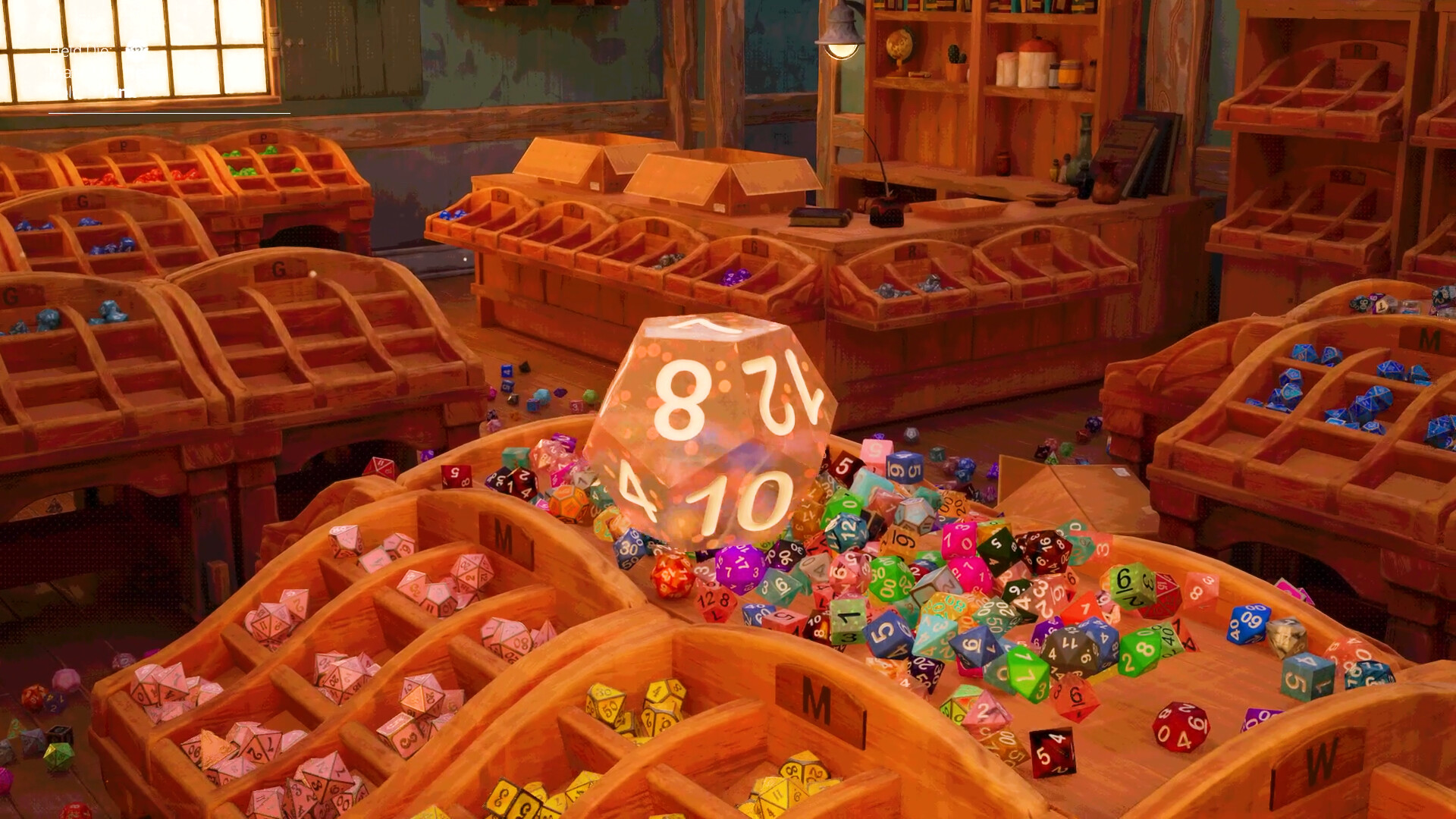
Guidance does one thing, and its line is almost blunt: it reveals the correct tray for the die you are holding. Not a hint, not a direction, not a highlight in the world — the tray. You hold a die, you fire the skill, and the game tells you where that specific die belongs.
That sounds like a small convenience until you remember what the shop actually is. The floor is organised by material first and colour second, the displays are labelled with alphanumeric codes, and the map is the only place that tells you which code takes which set. Every account of being stuck in this game comes back to the same bottleneck: you know the die you have, you know roughly which region it belongs to, and you cannot remember whether orange granite is the code you think it is. Guidance deletes that bottleneck. It does not help you find the die; it helps you file the die, which is the half of the loop that produces no dopamine and consumes the most doubt.
Its practical use is at the end of a set. When six pieces are placed and the seventh is in your hand, Guidance is the difference between two confident seconds and a minute of walking a coded map. The player who first found it judged it useless on the spot and said so, because at that stage of the run the shop was still small enough to hold in their head. That is a fair reading of the early game and a bad reading of the late one.
There is also a design joke buried in the name. Guidance is a cantrip in the tabletop game this shop is dressed as — the one that gives a small bonus to a check you are about to make. The digital assistant framing makes it funnier: the company’s training app has a spell that tells you where the company’s stock goes.
Critical Sort bets a whole set on one roll
Critical Sort is the strangest skill on the disk tree and the only one with a random element. Its line: roll a d20 for a chance to automatically restock an entire set. Not a piece. The set.
The mechanics take a moment to absorb, because the shop has spent the entire game refusing to let you skip work. You hold a d20, you activate the skill, and the die goes into the dice tray and rolls. If it beats the threshold, a complete set stocks itself. The player who found it first assumed they could spam it and discovered quickly that the roll has to happen in the tray, that the skill is bound to a key rather than the dice, and that the cooldown is the real cost. One player who had upgraded it twice still could not get a hit inside the session and ended the run without one, which is a fair warning about the variance.
What Critical Sort changes is the shape of the last third of a run. By then the shop is a volume problem rather than a discovery problem, and the honest way to finish it is a long grind of seven-piece assembly. Critical Sort is the only tool that converts a lucky moment into that grind being shorter, and it is aimed precisely at the players who have run out of interest in the loop but not out of the collection.
The upgrade steps are measurable, and they matter
The interesting part is that the thresholds have been read off in play, so the upgrade is not a mystery box. At base rank, a sixteen misses. With one upgrade, a sixteen hits. With the next, the number needed drops again and the roll gains advantage, which for a single d20 means rolling twice and keeping the better result. One player worked this out from a miss followed by a hit on the same roll value, and reported it in exactly those terms.
That progression is generous in a way the other skills are not. Most upgrades in this tree shorten a cooldown or add a die; Critical Sort’s upgrades move a probability, and because the underlying check is a d20, a change of two or three on the target number is a large shift in outcome. The difference between needing seventeen and needing fourteen is the difference between a novelty and a plan.
The ceiling condition is the one to plan around: a d20 must be in your hand to fire it, and the shop does not always have one lying loose. Players who lean on Critical Sort end up doing something the game never asks of them, which is hoarding a specific die type in a game about putting dice away.
The tree now has a shape, not a list
With seven of eight named, the roster splits cleanly into three jobs. Crouch, reach and sprint are travel: they reduce the cost of moving between the place you are and the place the die is. True Sight and Dice Summons are search: they tell you where the piece is, or bring it to you. Guidance and Critical Sort are filing: they remove the last uncertainty about where a held die goes, and in the extreme, remove the assembly step entirely.
That three-part split is a better explanation of the tree than the achievement list ever was, because it maps onto the three costs the shop actually imposes. Travel, search and filing are the whole game. Every skill attacks one of them, and the achievement that asks you to sort the entire shop without any spell skills now reads as a statement about how complete the manual loop already is: the powers are a convenience layer, all the way down.
The bindings fit that reading too. The abilities sit on number keys, and one player used four different keys for four different skills across a single run, with True Sight on two and Critical Sort on four in their layout. Nothing in the game forces a fixed order, which is worth knowing before you spend a point: the key you will reach for under pressure should be the one you use most, and that is rarely the one you learn first.
One slot is still blank
Seven of eight are named. The eighth has not been observed in any captioned run available here, and this page will not invent a name for it, a description, or an upgrade path. What can be said is that the remaining gap is now narrow enough to be specific: the roster has all three jobs covered, and every cost in the loop already has at least two answers. Whatever the eighth skill is, it is not filling an obvious hole, which is exactly why guessing at it would be worse than leaving the slot open.
The honest summary is that the tree is nearly complete and the completion has changed its character. Five names made the disks look like a travel upgrade path with a couple of oddities attached. Seven names make them look like a designed set of answers to the three problems the shop poses, and make the one remaining blank a genuinely interesting question rather than a missing row in a table.
Where this comes from
Source · tier 3
“Guidance reveals the correct tray for the die you are holding.”
Source · tier 3
“The player used Guidance and rated its upgrade highly.”
Source · tier 3
“Critical Sort: roll a d20 for a chance to automatically restock its entire set.”
Source · tier 3
“It has to be in the dice tray. A sixteen hits on the upgraded skill.”
Source · tier 3
“A sixteen missed before the upgrade, then sixteen hit, and the next tier hit on fourteen and rolled with advantage.”
Source · tier 3
“We finished the section, so we get a skill point. Level three now.”
Source · tier 3
“The upgrade summons an extra die and reduces the cooldown.”
Source · tier 3
“If I have this and press four. Oh, I can press two. That is right.”
Source · tier 1
“Multiclass Madness — Learn all eight skills.”
Source · tier 1
“No Magic, No Problem — Sort everything without spell skills.”
Checked 2026-11-16 against game version 1.0.1.