The night shift: how the shop actually tells its story
The basement door needs an employee ID card. The letters arrive at night. And you can only go to bed when the game decides it is dark. The story is not hidden so much as timed.
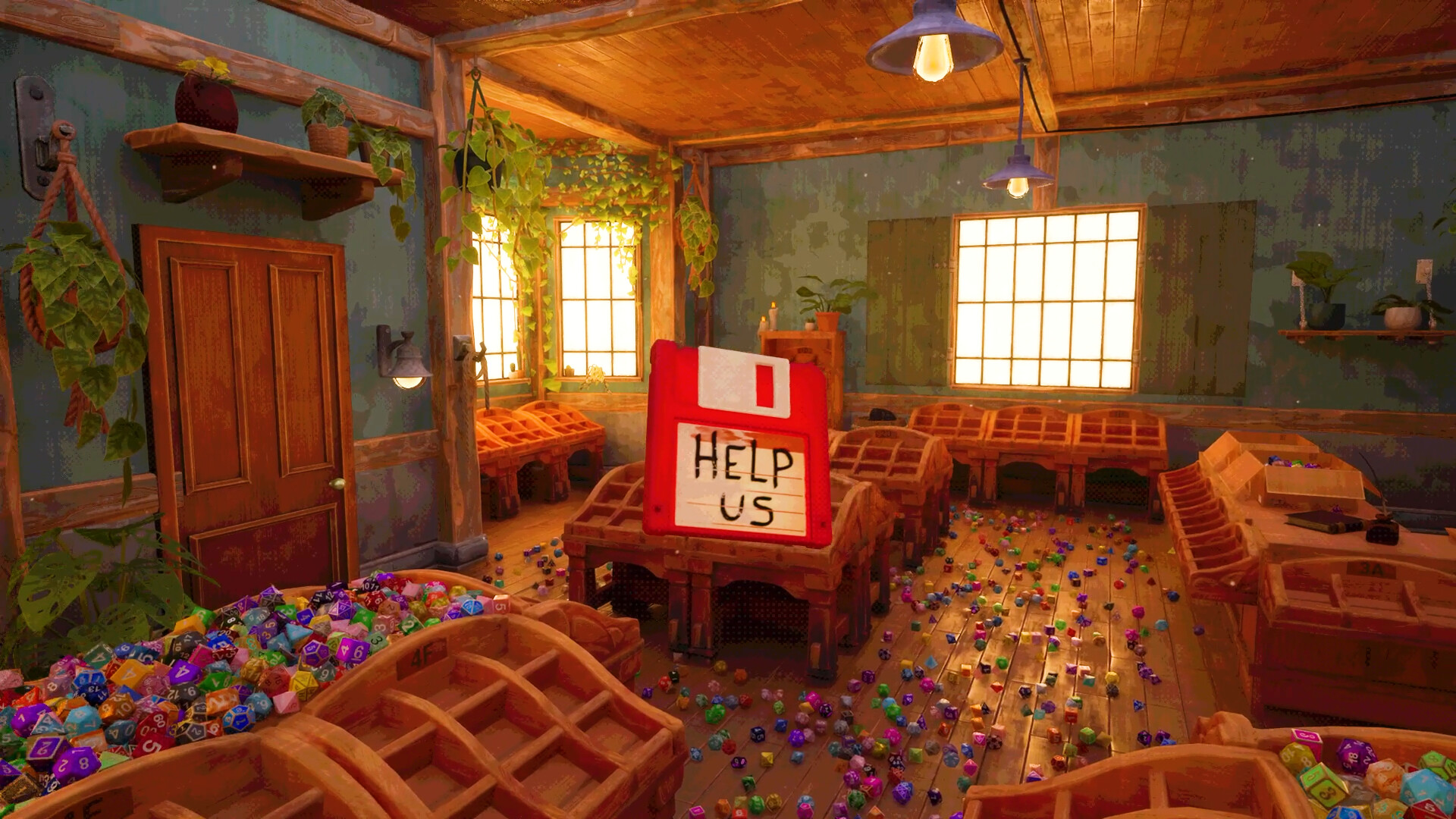
The premise is a job. You are hired to stock a dice shop, you are told everything you need is on the main floor, and you are told, once, to stay out of the basement. That is the whole of the setup: a warm room, a task with no clock on it, and one rule that exists purely so you will think about the room it refers to. What the game does not tell you is that it has a schedule for when that thinking is allowed.
The day ends when you go to bed, and the bed has hours
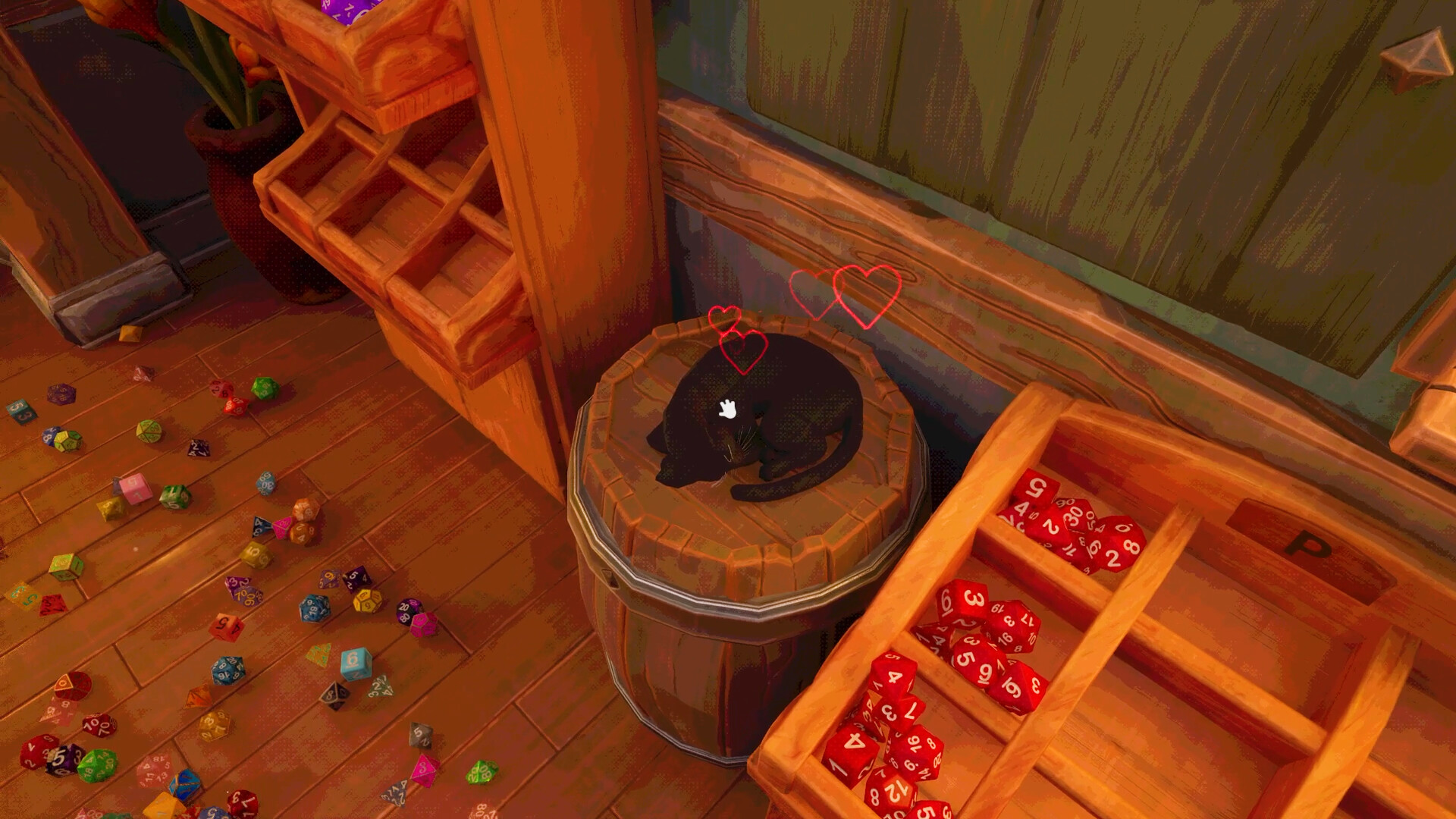
Story Mode is built from days, and a day does not end when a timer runs out — there is no timer — it ends when you sleep. The obvious assumption is that sleep is a button you press whenever you are finished, and several players made exactly that assumption, tried to bank a session mid-afternoon, and were told they could only sleep at night. The day has a shape, and the shape is not negotiable.
That single restriction does more work than it looks like it does. Because you cannot leave a shift whenever you like, the shop’s opening hours become real. You have a fixed window to hit the day’s stock target in, and if you finish early the remaining daylight is yours to spend on loose dice, a missing set piece, or hunting for whatever the day’s floppy disk is hidden behind. A game with no timer still has a closing time, and closing time is the bed.
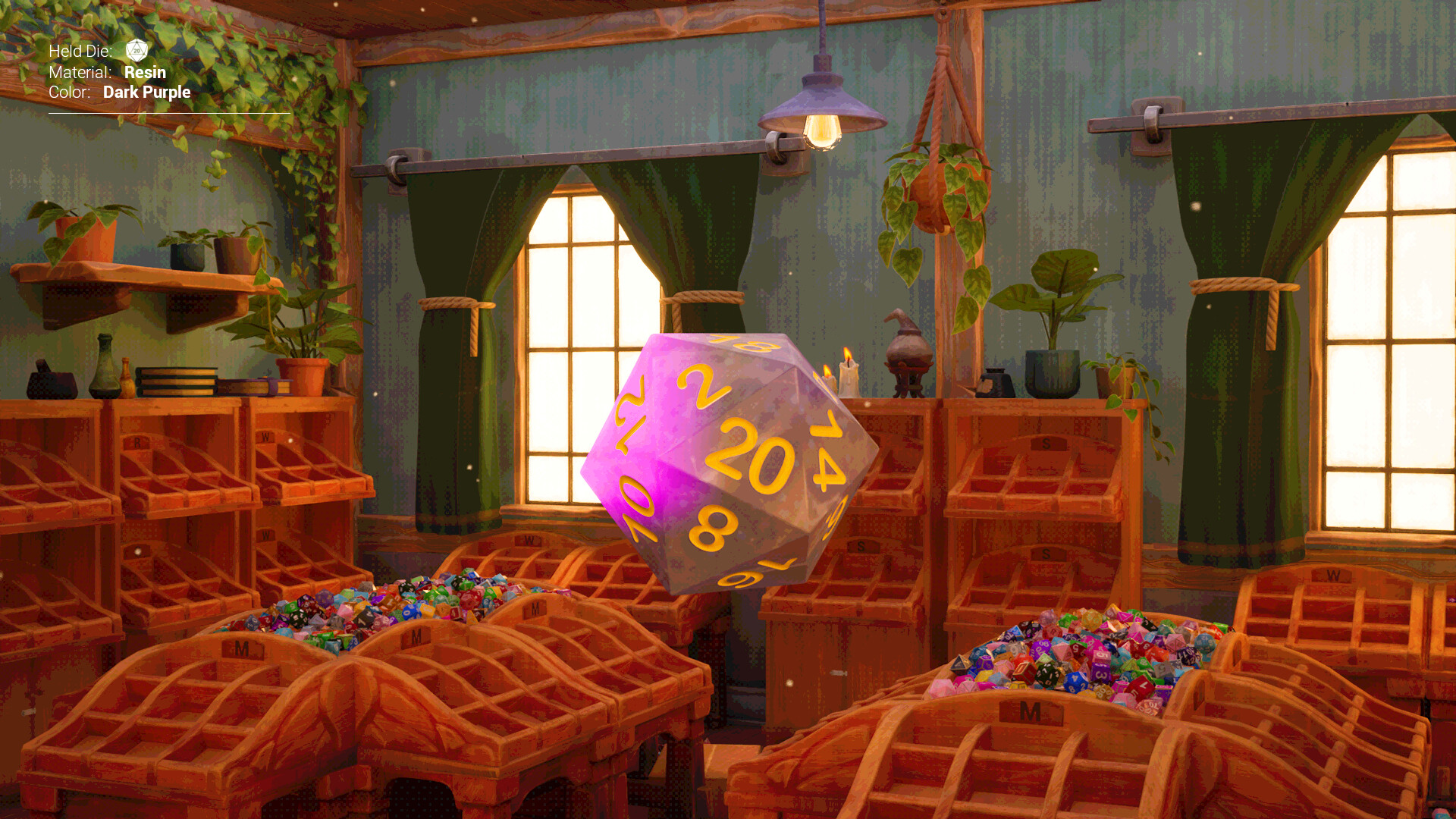
The night has its own loop, and it is not the daytime one
Once the shift ends, the game changes register. You are asked, in as many words, whether you would like to investigate a noise that woke you in the middle of the night, and the answer is offered as a choice rather than a cutscene. Saying yes hands you a flashlight — described by the player holding it, accurately, as a crappy one — and drops you back into the shop with the lights off and the ambient track swapped out.
This is the one place the game stops being cozy on purpose. The same room that was warm an hour ago is now the wrong room: shelves cast shadows, the floor is dark, and the corners you were sweeping by eye during the day are exactly where you cannot see. Nothing about the sorting rules changes. What changes is that you have been given a reason to be in the shop at night, and a light with a limited reach.
A first investigation can be trivially short. One player walked downstairs, found nothing, and went back to bed having decided the noise was nothing — which the game permits. Another treated the same prompt as an invitation and spent the event searching. Both are valid readings, and the design accommodates both, which is a rarer thing than it sounds: the story beat is available without being enforced.
Someone is writing to you, and it is not your employer
The letters are the part of the story that actually moves. They arrive signed by a private investigator, hired by the family of the person who worked the job before you, because that person went missing shortly after starting their training. The investigator writes at night specifically to avoid the company’s mail checks, and says so — which tells you two things at once: that the mail is monitored, and that the writer is not improvising.
The first request in that correspondence is small and specific: a red floppy disk is being sent as a test, and you are asked to keep an eye out in case it gets through. That is a lovely piece of structure, because it converts an abstract mystery into a thing you can look for while doing your actual job. You are not asked to solve anything. You are asked to notice a disk.
It also retroactively reframes the disks you have been installing all along. The game’s own store copy asks the question and declines to answer it — the disks are useful, but who keeps leaving them is another matter — and the correspondence supplies a second, competing explanation. Whether either is true is not something the opening days settle, and this page will not pretend otherwise.
The basement is locked, and the lock is a job perk
The basement door does not open because you are curious. It needs an employee ID card, which is a small, funny, and thoroughly deliberate obstacle: the rule you were given on day one is backed by a security system you do not yet have the credentials for. The shop’s own training assistant warns you off the room; the door enforces it.
The important consequence is that the basement is not a puzzle you can brute-force early. It is gated content, and the gate is employment. That makes the ID card one of the few concrete progression objects in a game whose other progression is measured in experience points and completed sets — and it means that when players describe the basement as the point of the whole thing, they are describing a door they cannot open yet, not a room they have seen.
What this means for how you play
Two practical readings follow. The first is that the story is on a clock you control only indirectly: days advance when you sleep, sleep requires night, and so the plot’s pace is set by how many shifts you finish rather than how many hours you put in. If you want the next beat, hit the day’s target and go to bed. If you want to tidy, tidy — but understand that you are not advancing anything except your own satisfaction.
The second is that night events are the only content in the game that can be missed by choice. Everything in the daytime loop is available whenever you want it. The noise in the dark, the flashlight, the walk through an unlit shop — those are offered, not imposed, and a player who always chooses bed will experience a shorter, calmer, entirely coherent version of the game in which the mystery is just a locked door and some odd mail.
That is a defensible design and an unusual one for the genre. The game is not hiding its story behind skill or collection; it is putting the story behind a decision that is easy to decline, and letting the player who declines it keep the cozy game they thought they bought. The only cost is that the two players will describe the same shop very differently afterwards.
Where this comes from
Source · tier 3
“A noise woke you up in the middle of the night. Would you like to investigate?”
Source · tier 3
“They give you a crappy flashlight.”
Source · tier 3
“I am a private investigator. The family of the person who worked here before you hired me to find them. She went missing shortly after starting her training.”
Source · tier 3
“The basement requires an employee ID card.”
Source · tier 3
“You can only sleep at night.”
Source · tier 1
“There are no timers and no need to rush. In Story Mode, the next day begins only after you have stocked the required value of dice.”
Source · tier 1
“Your employer gave you one clear rule: never enter the basement.”
Source · tier 1
“The disks are certainly useful. Who keeps leaving them for you is another question...”
Checked 2026-11-15 against game version 1.0.