The shop floor is the real puzzle: storage, materials and the display letters
The matching rule is easy. Finding the piece is the game. A shop full of unopened boxes and material-segregated displays turns sorting into a search problem — and the day-one hotfix admits how often players got it wrong.
Strip the story out and Dice Hoarder is two problems wearing one coat. The first is a matching problem: a complete set is seven dice that agree on colour and material, and the game will not stock a set that disagrees. The second is a search problem: those seven dice are distributed across a shop full of shelves, crates, floor piles and boxes, and the search is the part that actually consumes a shift.
Most guides stop at the first problem. The second one is where the hours go, and the launch build is full of small, deliberate obstacles between you and the die you already know you need.
Half the stock is inside something
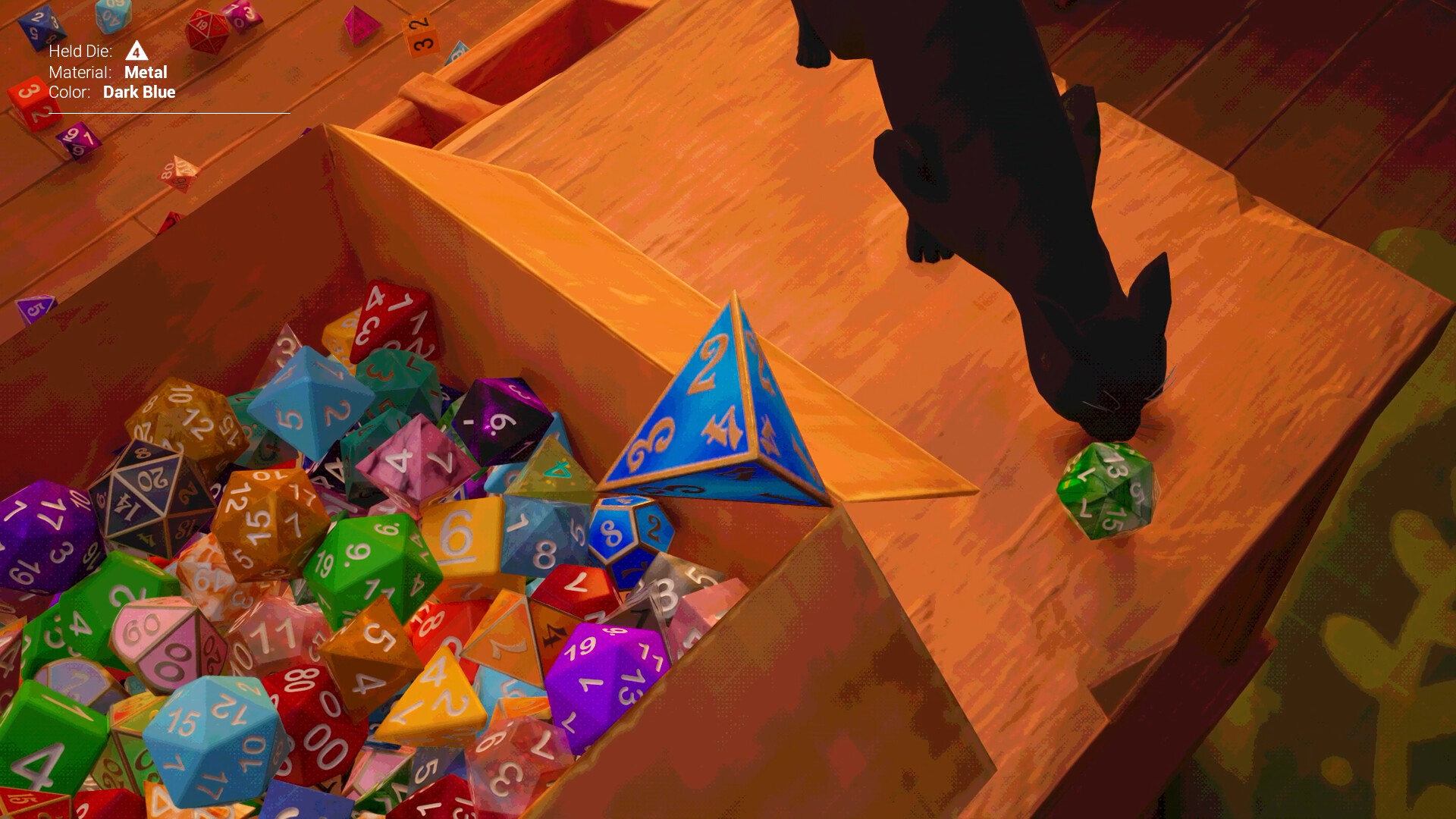
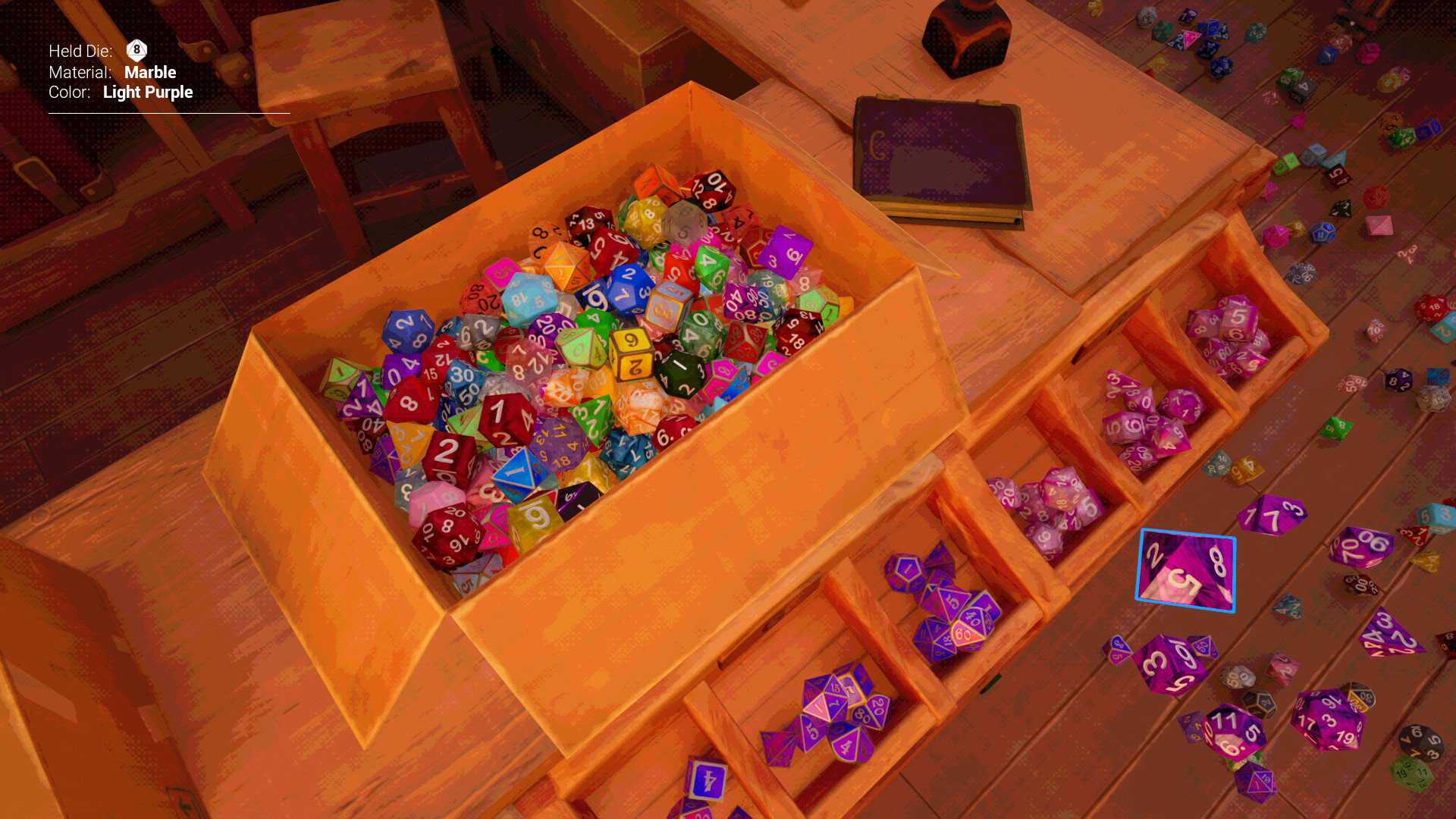
The single most common way to be stuck in this game is not to have mis-sorted anything. It is to have never opened the container. Crates and boxes in the shop are interactable, they hold dice, and they are not obviously different from boxes that are scenery. One player spent the better part of a session unable to find the last few pieces of several sets, gave up on the shop floor entirely, and then opened a box that had been sitting at an angle in a corner the whole time — and found the entire missing gemstone range inside it.
That is a design decision rather than an accident, and it has a clear lesson attached: when a set will not close and the floor is bare, stop searching surfaces and start opening things. The shop’s clutter is not decoration. Boxes that look like set dressing are, at least sometimes, the inventory.
There is a related failure the day-one hotfix had to address, which tells you how common it was: players who quit the game while holding a box could find it floating after reload, permanently stuck. The boxes are not just containers; they are physics objects you can carry, and they can go wrong.
Material families live in different places
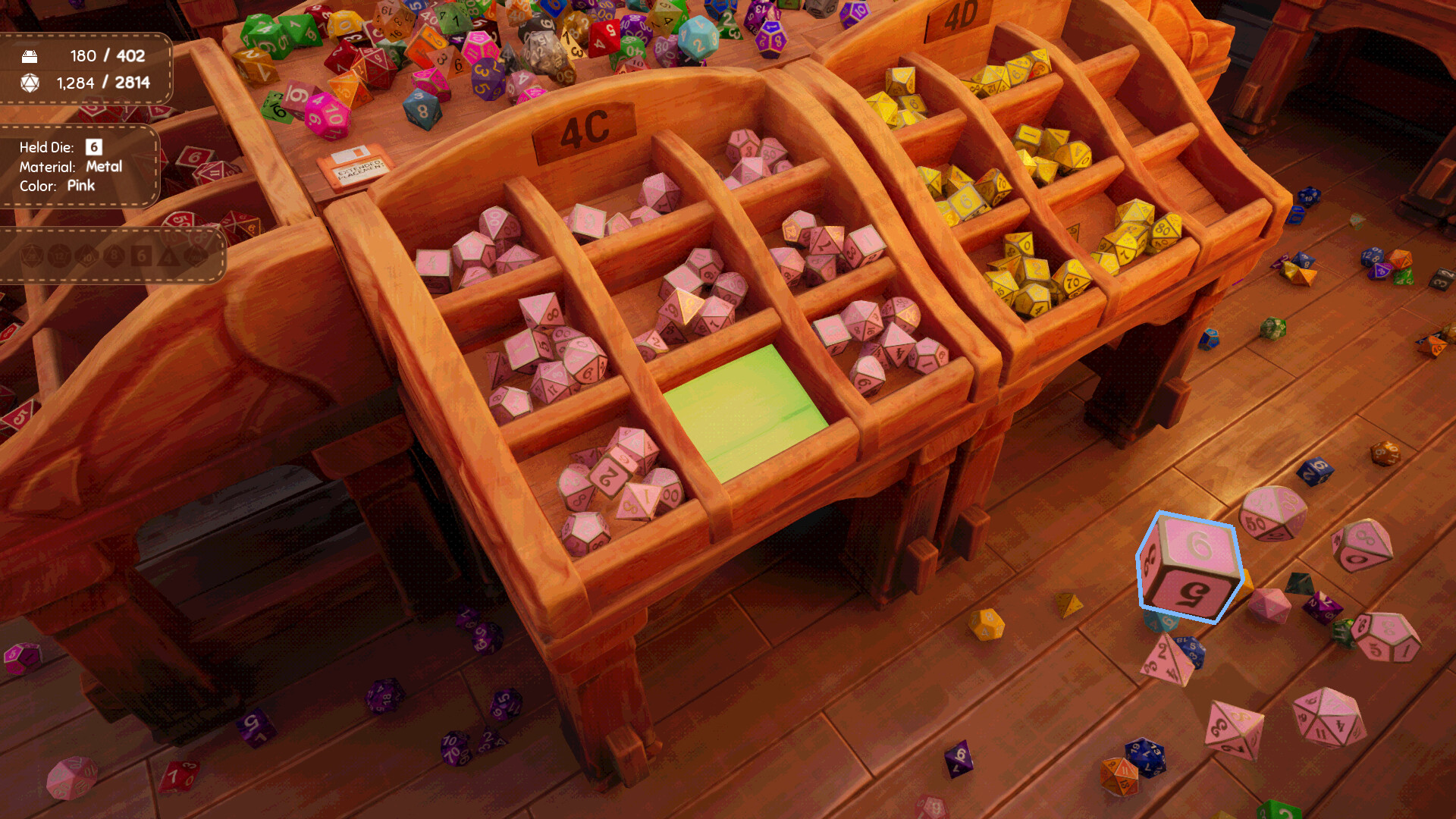
The second structural surprise is that the shop is not organised by colour. It is organised by material. A player scanning for orange will find orange plastic, orange resin, orange liquid-core resin, orange metal, orange granite, orange gemstone and orange bone, and those are not interchangeable — they belong on different displays, and the display codes you read off the map tell you which is which.
The realisation tends to arrive late and all at once. One player had been sorting by hue for an hour before noticing that there were separate boxes for granite and for liquid core, and that the reason a set kept refusing to stock was that a die of the right colour had the wrong finish. Once you see the material split, the shop stops looking like a pile and starts looking like a map with several overlays.
The material list itself is wider than the store page implies. Between the shelves you will meet plastic, resin in both solid and clear forms, liquid-core resin with something suspended inside, metal, stone varieties including granite and marble, gemstones, and bone. That is a lot of categories for a game whose marketing describes it as sorting by colour and material — and it is why the identification panel matters so much.
The colourways have names, and the names are jokes
A detail that is easy to miss because it is purely flavour: the sets are named. You will meet a colourway called Sunset Dreamer, a swirled red one called Lollipop, a pale yellow one filed under Cheese, dice with dragon and dinosaur faces on them, a ladybug set, and stone-flavoured ranges like Tiger’s Eye and Dragon Eye.
The names do real work, in a small way. Because the shop organises by material and the displays carry codes rather than names, the name is often the only memorable handle on a set — and the game leans into how silly they are. Cheese dice in stock is a line that lands because the shop is genuinely, unironically stocking cheese.
There is a practical consequence too. Two dice of the same nominal colour can belong to named sets that are very close in hue, and the name is what tells you they are different families rather than a mistake. If you are stuck on a set that looks complete, check whether the pieces you have actually share a name.
The display letters are the interface you are not using
The shop’s layout map assigns alphanumeric codes to display positions, and hovering a display on the map tells you which set belongs there. This is the game’s answer to the search problem, and it is available from the first shift — but it is delivered as a training step, buried under a screen you may click through, and it is easy to conclude that the shop wants you to memorise the room instead.
It does not. Reading the code off the map and walking to it is faster and more reliable than scanning shelves, particularly once the material split means there may be three orange displays. The players who describe the shop as chaotic are usually the ones who never opened the map.
A wrong placement now announces itself
The most useful change in the day-one hotfix is a piece of feedback rather than content: when a die goes onto the wrong display, the display letters glow red and the game plays a sound. Before that, a mis-stock was silent. You could place a die, get no confirmation, and only discover the mistake much later when a set refused to close for reasons you could not see.
That is a small patch note with a large effect on how the game teaches. Silent failure is the worst possible feedback in a sorting game, because the player cannot tell the difference between a wrong decision and a bug. Turning the letters red does not make the rule easier; it makes the rule visible, which is what a game about identifying dice by properties actually needs.
The rest of the hotfix list reads like a confession of the same problem in other places: dice loading into a completed slot after a save, a softlock at night, movement breaking while holding the resin mold, a hover tip that would not clear, and floppy disks that stayed invisible until a reload. None of those are design failures. They are all cases where the shop was doing something the player could not see.
Crafting has a shape, and it is a real interface
The crafting bench is where the search problem gets an escape hatch. When the shop is short on stock, the game asks you to make resin dice yourself, and the process is more than a button: you choose a main colour and a mix colour, choose whether to add glitter, then choose or design a pattern, then set its density and scale before adding resin to the mould and pouring it.
Two things follow. First, the dice you make are genuinely yours — the shop will accept a set you assembled from a batch you designed, which is a different feeling from finding one. Second, crafting is slow. The mould has to cure, and one player used the waiting time to go back to sorting and let the dice finish without watching. That is not a bug; it is the game declining to let the shortcut be instant.
Crafting also shares the same rule as everything else. A die you made still has to match colour and material to belong in a set. Making dice does not let you cheat the matching logic; it lets you fill a gap that the shop’s own stock could not fill, and it costs you the time the cure takes.
What the floor is actually teaching
Put together, the shop is a lesson in reading a space rather than a lesson in matching colours. The dice are not hidden; they are distributed. Material splits the room, codes index it, containers conceal parts of it, and the only real skill is knowing which of those four things to check next when a set stalls at six.
The day-one patch is the developers admitting the same thing from the other side. Almost every fix on that list is about making the shop’s state legible: where a die went, whether a slot is right, whether a disk exists. A cozy game still has to be readable, and the fact that this one shipped a hotfix about exactly that is the most honest thing in its patch history.
Where this comes from
Source · tier 1
“When a die is placed in the wrong display, the display letters now glow red and play a sound.”
Source · tier 1
“Dice you pick up can now go straight into your inventory. You can now open the map with a keybind. Zoom can now be set to toggle in the Accessibility settings.”
Source · tier 1
“If you exit the game while holding a box, the box can float after you load back in. Fixed floppy disks being invisible until a reload for some players. Fixed a softlock during nighttime. Fixed players not getting extra skill points after reaching max level.”
Source · tier 3
“Main colour, mix colour, glitter, design, density and scale, then add resin to the mould.”
Source · tier 3
“They are separated by material: this is the plastic one, this is resin.”
Source · tier 3
“Store layout: visit the map and hover over the dice displays to find where a set belongs.”
Source · tier 3
“Good news, we have cheese dice in stock. Lollipop red.”
Source · tier 1
“The shop is running low on stock, so you will be able to craft custom resin dice to help fill the gaps.”
Source · tier 1
“Pick them up, examine their colours and materials, and rebuild 400+ seven-piece dice sets. Each set needs one of every classic polyhedral die: a percentile die, D4, D6, D8, D10, D12, and D20.”
Checked 2026-11-15 against game version 1.0.